Many enterprises frequently encounter this question during the procurement process: What is the difference between office headsets and consumer headsets? Can ordinary headsets be used as a substitute?
On the surface, both can be used for listening to music and making calls, and ordinary headsets are often cheaper. However, in real-world office scenarios, especially in high-frequency environments such as call centers, remote conferencing, and customer communication, the differences become rapidly apparent.
As a manufacturer specializing in UC headsets (Unified Communications Headsets), we have found in our actual projects that many enterprises initially choose ordinary headsets but ultimately repurchase professional office headsets.
The reason is simple—the usage scenarios are completely different.
An office headset is essentially a device “centered on communication efficiency.”
It is primarily used in call centers, customer service and technical support teams, sales communication positions, and remote work and video conferencing (Teams/Zoom).
Compared to regular headsets, office headsets prioritize the following:
Microphone noise cancellation (ensuring the other party can hear clearly)
Comfort during extended wear (suitable for 6-8 hours of use)
System compatibility (supporting mainstream UC platforms)
Connectivity stability (USB or professional Bluetooth solution)
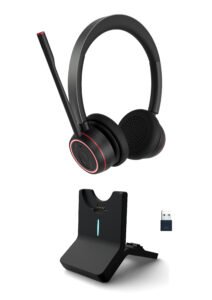
In actual enterprise use, these headsets are often referred to as business headsets or UC headsets.
A regular consumer headset is primarily designed for individual users.
Common usage scenarios include: listening to music, playing games, and everyday calls.
The design focus of these headsets is: sound quality (especially bass), appearance, and portability.
However, a key point is that they are not designed for “long-term communication.”
Office Headset vs. Consumer Headset: What are the core differences?
From a product design perspective, the differences between office headsets and regular headsets are very obvious.
| Feature | Office Headset | Consumer Headset |
|---|---|---|
| Microphone | Noise-canceling, voice-focused | Standard microphone |
| Usage Time | Designed for long hours | Short-term use |
| Compatibility | Optimized for Teams, Zoom & UC platforms | Limited compatibility |
| Durability | Built for daily professional use | Consumer-grade |
| Audio Focus | Clear voice communication | Music and entertainment |
Simply put, this is the difference between a “tool-type product” and an “entertainment-type product”.
Why is it not recommended to use a regular headset for office work?
Many companies have tried using consumer headsets for office work, but they usually encounter the following problems:
In open-plan office environments, ambient noise is unavoidable.
Without a professional noise-canceling microphone, the other party often hears: keyboard sounds, human voice interference, and background noise, which directly affects the customer experience.
In call center scenarios, employees typically wear headsets for more than 6 hours a day.
Common problems with ordinary headsets include: ear pressure, head clamping, and overheating.
While this may be acceptable in the short term, it will impact work efficiency in the long run.
When using platforms like Teams and Zoom, ordinary headsets may experience: unstable connections, unusable control functions, and cumbersome device switching.
This is a major reason why many companies later switch to UC headsets.
Consumer-grade headsets are not designed for high-frequency use. Long-term use leads to: high failure rates, frequent replacements, and increased hidden costs.
If your company is a call center (high-frequency calls), customer service team, sales team, or remote work team, it is recommended to prioritize an office headset for business.
These scenarios share a common feature: communication efficiency directly impacts business results.
Cost vs. Value: Are Office Headsets More Worthwhile?
Many procurement professionals focus on price initially, but long-term value is even more important.
Regular headsets: Low initial cost, short lifespan, low communication efficiency
Office headsets: Slightly higher initial cost, stable operation, improved overall efficiency
In actual projects, our clients often find after a period of use that: The real cost is not price, but efficiency.
How to Choose the Right Office headset for Your Business?
If you are looking for the best office headset, we recommend focusing on the following:
Why Choose a Professional UC headset Manufacturer?
For enterprise clients, choosing a supplier is equally crucial.
As a manufacturer specializing in UC headsets, we typically provide our clients with:
Stable production capacity: Supporting large-volume order fulfillment
OEM/ODM customization capabilities: Supporting brand customization, feature adjustments, and packaging design
Cost advantage: Direct factory supply, resulting in more competitive pricing
Complete certification system: Compliant with international standards such as CE, FCC, and ISO.
For long-term clients, these capabilities are often more important than a single product.
Office headsets and regular headsets are not simply substitutes.
The former are professional tools designed for enterprise communication scenarios, while the latter are consumer products geared towards personal entertainment.
If your business relies on communication efficiency, then choosing a suitable office headset is not just an equipment upgrade, but an overall improvement in efficiency.
Yes, but they are significantly inferior in terms of call quality, comfort, and stability.
The core difference is that office headsets emphasize clear calls and extended use, while regular headsets are more geared towards entertainment.
UC headsets are specifically optimized for unified communications platforms such as Teams and Zoom.
We recommend choosing a professional office headset with a noise-canceling microphone, good compatibility, and high comfort.

I am David, a product engineer at Huizhou Boxin Electronics Co., Ltd. If you are interested in our headsets, please contact me.